[KDDF 기고_김순남] 비소세포성 폐암과 치료제 개발
- 2013.04.01
- 2,885


비소세포성 폐암과 치료제 개발
범부처신약개발사업단 김순남 전문위원
-
1. 질환 개요
NSCLC는 American Joint Committee on Cancer (AJCC) TNM (tumor, node, metastasis) classification system을 사용하여 Primary tumor status(T), nodal status(N), metastasis(M)에 따라 7단계로 분류된다 (NCCN guidelines, 2012).
2. 증상
폐암의 일반적인 증상은 다음과 같다.객혈 (Hemoptysis, coughing up blood or blood-stained sputum)
체중저하 (loss of weight)
식욕저하 (loss of appetite)
호흡곤란 (dyspnea, short of breath)
흉부 통증 (thoracic pain)
피로와 기침 (fatigue and cough)
곤봉지 (finger clubbing)
혈소판증가증(thrombocytosis)
비정상적 폐활량 (abnormal spirometry)
-
3. 진단
표 1. Non-small cell lung cancer 5-year survival rates, by stage at diagnosis, 2002-08
| Stage at diagnosis | TNM stage | 5-year relative survival rate(%) |
|---|---|---|
| Localized (confined to primary site) | I–II | 52.2 |
| Regional (spread to regional lymph nodes) | III | 25.1 |
| Distant (cancer has metastasized) | IV | 3.7 |
| Unknown (unstaged) | n/a | 7.9 |
| TNM = tumor, node, metastasis. | ||
4. 치료방법 및 치료약물
NSCLC 치료는 진단시의 암 단계에 따라 달라지고 외과 절제술, 방사선 치료, 항암제 및 표적 치료제 치료 단독 또는 병용으로 사용된다.표 2. NSCLC의 치료법
| Stage/ Tumor Type |
TNM code | Treatment |
|---|---|---|
| Stage IA | Peripheral T1ab, N0 |
Surgical resection (wedge/lobectomy) with or without radiation therapy |
| Stage II | T1, N1, M0 T2, N1, M0 T3, N0, M0 |
Lobectomy, pneumonectomy, segmental, wedge or sleev resection as appropriate Radiation therapy with curative intent for potentially operative in patients with medical contraindications to surgery Adjuvant chemotherapy after curative surgery |
| Stage IIIA | T1, N2, M0 T2, N2, M0 T3, N1, M0 T3, N2, M0 |
Surgery is an option if the tumor is resectable, followed by adjuvant chemotherapy If the tumor is unresectable the patient is given chemoradiation In case the patient is unfit for combined modality therapy, they are given radiation therapy alone |
| Superior sulcus tumors |
T3, N0, M0 T3, N1, M0 |
Radiation therapy and surgery Radiation therapy alone Surgery alone Concurrent chemotherapy with radiation therapy and surgery |
| Chest wall tumor |
T3, N0, M0 T3, N1, M0 |
Surgery alone Surgery and radiation therapy Radiation therapy alone Chemotherapy combined with radiation therapy and/or surgery |
| Stage IIIB | Any T, N3, M0 T4, anyN, M0 |
Surgery followed by chemotherapy if margins are negative Surgery followed by concurrent chemoradiation if the margins are positive and if it is tolerated by the patient |
| Stage IV | Any T, Any N, M1a or M1b |
Depending on the site of metastasis and the size of the tumor, treatment would include surgery, chemotherapy, chemoradiation therapy, radiation therapy or a combination of any or all of these |
NSCLC 치료와 전이에 사용되는 항암요법은 다음과 같다.
표 3. NSCLC에 사용되는 항암요법
| Adjuvant Therapy | |
|---|---|
| Regimen | Duration |
| Cisplatin 50mg/m2 days one and eight Vinorelbine 25mg/m2 days one, eight, 15 and 22 |
Every 28 days for four cycles |
| Cisplatin 100mg/m2 day one Vinorelbine 30mg/m2 days one, eight, 15 and 22 |
Every 28 days for four cycles |
| Cisplatin 75–80mg/m2 day one Vinorelbine 25–30mg/m2 days one and eight |
Every 21 days for four cycles |
| Cisplatin 100mg/m2 day one Etoposide 100mg/m2 days 1–3 |
Every 28 days for four cycles |
| Cisplatin 80mg/m2 days one, 22, 43 and 64 Vinblastine 4mg/m2 days one, eight, 15, 22 then every two weeks after day 43 |
Every 21 days for four cycles |
| Other acceptable cisplatin based regimen | |
| Cisplatin 75mg/m2 on day one Gemcitabine 1,250mg/m2 on days one and eight |
Every 21 days |
| Cisplatin 75mg/m2 Taxotere (docetaxel) 75mg/m2 |
Every 21 days |
| Alimta (pemetrexed) 500mg/m2 on day one Cisplatin 75mg/m2 on day one |
Every 21 days for four cycles |
| For patients with comorbidities or patients not able to tolerate cisplatin | |
| Paclitaxel 200mg/m2 on day one Carboplatin AUC 6 on day one |
Every 21 days |
| Chemotherapy regimens used with radiation therapy | |
| Concurrent chemotherapy/RT regimens | |
| Cisplatin 50mg/m2 days one, eight, 29 and 36 Etoposide 50mg/m2 days 1–8, 29–33 Concurrent thoracic RT (preferred) |
|
| Cisplatin 100mg/m2 days one and 29 Vinblastine 5mg/m2/ five times weekly Concurrent thoracic RT (preferred) |
|
| Paclitaxel 45–50mg/m2 weekly over one hour Carboplatin AUC = 2mg/ml/min over 30 min weekly Concurrent thoracic RT |
|
| Concurrent chemotherapy/RT followed by chemotherapy | |
| Cisplatin 50mg/m2 days one, eight, 29 and 36 Etoposide 50mg/m2 days 1-8, 29-33 Concurrent thoracic RT Followed by Cisplatin 50mg/m2 and Etoposide 50mg/m2 x 2 additional cycles |
|
| Paclitaxel 45–50mg/m2 weekly Carboplatin AUC 2, concurrent thoracic RT Followed by 2 cycles of Paclitaxel 200mg/m2 and Carboplatin AUC 6 |
|
RT-Radiation therapy, AUC- Area under curve
표 4. NSCLC의 전이에 사용되는 치료제
| First-line | |
|---|---|
| Avastin (bevacizumab) + chemotherapy or chemotherapy alone (PS 0-1) | 4–6 cycles, Avastin given until disease progression |
| Erbitux (cetuximab) + vinorelbine/cisplatin (PS 0-2) | 4–6 cycles |
| Tarceva (erlotinib EGFR mutation positive patients) | Given until disease progression (median duration 9.9 weeks*) |
| Second line | |
| Single-agent docetaxel, Alimta, erlotinib | |
| Third-line | |
| Tarceva | |
| Maintenance therapy | |
| Continuation of Avastin after 4–6 cycles of platinum -doublet chemotherapy and Avastin |
|
| Continuation of Erbitux after 4–6 cycles of cisplatin, vinorelbine, and Erbitux | |
| Continuation of Alimta after 4–6 cycles of cisplatin and Alimta for patients with histologies other than SCC |
|
| Initiation of Alimta after 4–6 cycles of first-line platinum -doublet chemotherapy for patents with histologies other than SCC |
|
| Initiation of Tarceva after 4–6 cycles of first-line platinum -doublet chemotherapy |
|
| Initiation of Taxotere after 4–6 cycles of first-line platinum -doublet chemotherapy |
*Tarceva Prescribing Information
5. NSCLC와 관련된 유전자 돌연변이
NSCLC환자의 유전자 돌연변이 유형에 따라 적절한 표적 치료제를 선택할 수 있는데 EGER, KRAS 및 anaplastic lymphoma kinase(ALK)가 알려져 있다.표 5. Oncogene Mutations - Prevalence and Predicted Response Rates
| Oncogene | Mutation Prevalence | Mutation-Predicted Therapeutic Response | Predicted Response Rate |
|---|---|---|---|
| EGFR | Asians: 40% Caucasians: 10-15% |
Sensitive to EGFR TKIs | Tarceva: ~82% Iressa: ~73% |
| KRAS | Asians: 10% Caucasians: 30% |
Resistant to EGFR TKIs | Data not available |
| ALK | 5% | Sensitive to ALK inhibitors, Resistant to EGFR TKIs |
Xalkori (crixotinib): ~57% |
6. 시장전망
- 6.1 성장예측
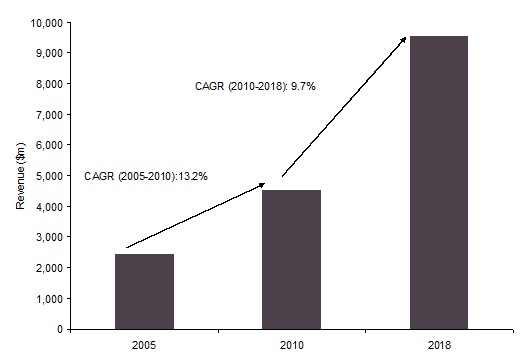
그림 1. NSCLC Therapeutics, Global, Revenue and Market Forecast ($m), 2005-2018
출처: GlobalData, SEER, Globocan 2008, GlobalData Epidemiology-based Market Forecasting Model, Primary Research Interviews, Key Opinion Leaders (KOL) Interviews
6.2 파이프라인 분석
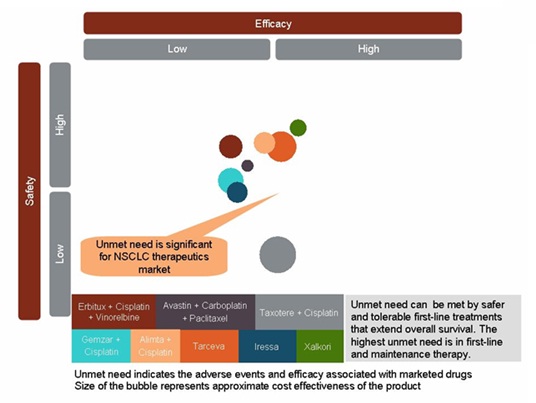
현재 치료 방법은 cisplatin, caboplatin, vinorelbine 같은 non-specific, non-selective chemotherapeutic agent로서 생존기간 연장에서도 효과가 충분치 못하고 부작용을 동반하기 때문에 환자의 삶의 질을 감소시킨다. 시장에서 가능한 표적 치료제는 소수의 환자에게는 도움을 주지만 NSCLC 전체를 표적으로 할 수 있어서 신규 치료제에 대한 수요가 많다.
현재 시판된 주요 치료제는 다음과 같다.
- ●Avastin (bevacizumab; Genentech/Roche/Chugai)
- ●Iressa (gefitinib; AstraZeneca)
- ●Tarceva (erlotinib; Roche)
- ●Xalkori (crizotinib; Pfizer)
- ●Halaven (eribulin; Eisai)
- ●GSK1572932A (astuprotimut-r; GlaxoSmithKline)
- ●Lucanix (belagenpumatucel-L; NovaRx)
- ●Dacomitinib (PF-00299804; Pfizer)
- ●Erbitux (cetuximab; Eli Lilly/Bristol-Myers Squibb/Merck KGaA)
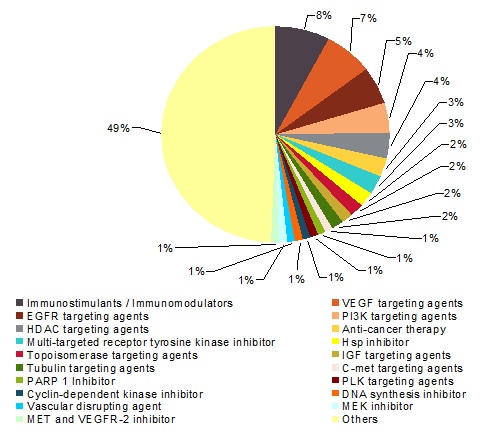
다양한 기전의 181개 물질이 임상단계에서 개발 중이고 이들 중 169개는 first-in –class 이고 11개는 me-too 물질로 분류된다. (Pharma eTrack Nov. 2011)
그림 2. Clinical Pipeline by Mechanism of Action, 2011
- 출처: Pharma eTrack Nov. 2011
6.3 미충족 의학적 수요
NSCLC은 시장을 지배하고 있는 Taxtore, Gemzar 및 Alimta 같은 표적 치료제들이 생존기간 연장의 효과는 보이지만 독성을 수반하고 늦은 단계에서 진단되기 때문에 치료 효과는 충분치 못하며 고가의 약이 대부분이다. 따라서 효과 및 비용면에서의 미충족 수요가 높다.
그림 3. Opportunity and Unmet Need in NSCLC Therapeutic Market
출처: GlobalData, GlobalData Epidemiology-based Market Forecasting Model, Primary Research Interviews, KOL Interviews, Prescribing Information
- 6.4 미래시장전망
- 이전 [KDDF 기고_신상훈] 효소대체 치료법 : 발상부터 완성까지 2013.03.04
- 다음 [전문가특별기고_장민선] 선도물질 및 후보 선정을 위한 탐색적 독성학 2013.05.06